

Dependency Track
STILL UNDER CONSTRUCTION
Introduction
Dependency-Track is an open-source Software Composition Analysis (SCA) tool that helps organizations manage and secure their software supply chain. It automatically generates and maintains a Software Bill of Materials (SBOM) for projects, continuously monitoring dependencies for known vulnerabilities. In addition, it tracks license compliance of open-source components, giving teams greater visibility and control. By integrating seamlessly into DevOps and CI/CD pipelines, Dependency-Track makes it easier to embed security throughout the development lifecycle.
There are several useful resources available to get started with Deptrack:
Dependency-Track Documentation
Accessing Dependency-Track
Dependency-Track is integrated into the DevOps-as-a-Service toolchain, but for now it’s only offered in the Pilotkunden Preview. To get started, a few prerequisites need to be in place.
Preconditions in DevOps portal to access Dependency-Track
- A Dependency-Track license must be assigned to the user
- Dependency-Track must be added to the tool list of the project
After completing the preconditions, a project in Dependency-Track, which is part of the DevOps-as-a-Service toolchain, can be accessed via the DevOps Portal or directly through a URL.
Via DevOps Portal
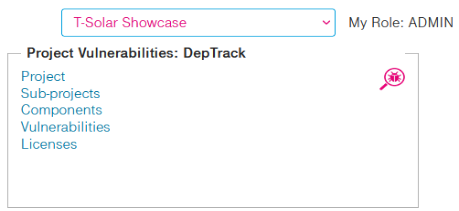
Go to the DevOps Portal Homepage and click on the link Project in the Project Vulnerabilities tile:
Via Direct URL
You can also access Dependency-Track directly using the following link format:
https://deptrack-<customer>.devops.t-systems.net/projects where <customer> is the id of your DevOps-as-a-Service instance.
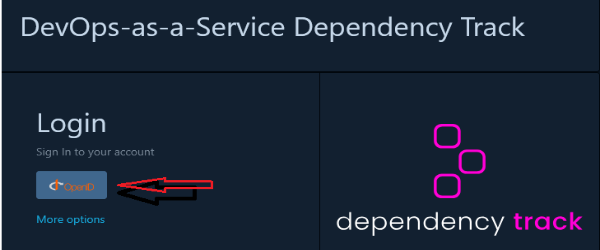
If you are not already logged in to another tool in the toolchain or the DevOps portal, then you have to login using your configured SSO credentials.
Projects
Dependency-Track Jenkins Integration
When using sdcPipeline(), Maven projects automatically generate a Software Bill of Materials (SBOM) and are pushed to Dependency-Track. This process is fully automated through the provided pipeline library. Currently, this option is only available for Maven projects.
Collection Project
In Dependency-Track, these Maven builds are organized under a Collection Project. Subprojects (for example, individual modules of a Maven project) are created as children of the DevOps portal project. This makes it easier to see aggregated metrics, such as vulnerabilities and license compliance, without having to open each subproject individually.
For more details, see the Collection Projects section in the Dependency-Track documentation.
Users and Roles
- Projects, users and their roles in projects are managed in the DevOps Portal, the corresponding functions in Dependency-Track are disabled (UI and API)
- When Dependency-Track is added as a tool to an existing or new project, a corresponding Dependency Track project is automatically created. Users assigned to the project in the DevOps Portal are then added to it with the roles defined in the configuration :
- Role mapping:
Project Role in DevOps Portal Permissions in Dependency-Track Admin POLICY_VIOLATION_ANALYSIS, VIEW_POLICY_VIOLATION, VIEW_PORTFOLIO, VIEW_VULNERABILITY, VULNERABILITY_ANALYSIS Master POLICY_VIOLATION_ANALYSIS, VIEW_POLICY_VIOLATION, VIEW_PORTFOLIO, VIEW_VULNERABILITY, VULNERABILITY_ANALYSIS Developer POLICY_VIOLATION_ANALYSIS, VIEW_POLICY_VIOLATION, VIEW_PORTFOLIO, VIEW_VULNERABILITY, VULNERABILITY_ANALYSIS Viewer VIEW_POLICY_VIOLATION, VIEW_PORTFOLIO, VIEW_VULNERABILITY
- Role mapping:
Main Features
Inside DevOps-as-a-Service, deptrack is mainly used for writing specifications and documentations. See below for a list of the main features of XWiki.
Auditing Basics
Dependency‑Track offers a robust auditing workflow: you can triage findings on individual projects, add comments, and record analysis decisions. The platform logs a complete audit trail for each action. Users with the VULNERABILITY_ANALYSIS permission can perform these audits, and audit histories are visible to anyone with the VIEW_VULNERABILITY permission.
Impact Analysis
Dependency‑Track enables organizations to assess how a vulnerability affects their environment. If a vulnerability is published in a supported datasource (e.g., NVD, GitHub Advisories, OSS Index, VulnDB), the platform dynamically identifies all affected projects. This allows you to answer: "What is affected?" and "Where am I affected?" at a glance. docs.dependencytrack.org
Analysis States
Dependency‑Track tracks the status of findings through their lifecycle via "analysis states". These help teams understand whether findings are new, under review, suppressed, or resolved. You can reference the Analysis States section in the documentation for full details on available statuses and workflows. docs.dependencytrack.org +1